Why Your Garden Looks Different Every Time You Feel Overwhelmed

On a good day, you step outside and see a garden. A few weeds here, a rose that wants deadheading, nothing that can't wait until tomorrow if it has to. On a bad day, the same patch of ground looks like an emergency. Within about sixty seconds you've catalogued everything that needs doing, calculated the hours you don't have, and gone back inside feeling worse than when you walked out. Nothing about the garden itself changed between those two mornings. You did.
This is worth taking seriously rather than brushing off as "just being in a mood," because it explains something that trips up a lot of gardeners: the sense that the garden keeps getting away from you, when really what keeps shifting is how much your mind can take in on any given day.
The garden didn't change. You did
It's easy to treat your read of the garden as an objective fact — this is what the garden looks like, full stop. But two people standing in the exact same spot, on the exact same day, will often see two entirely different gardens. One sees three hundred jobs and a space that's become too large to look at. Another, standing in that same spot a week later in a calmer state of mind, sees three weeds and a rose that wants attention. Same soil, same plants, same weather. Different capacity to take it in.
That difference isn't a character flaw, and it isn't evidence that you're bad at gardening on the days it feels overwhelming. It's a fairly ordinary feature of how a tired mind processes an open-ended space full of small, competing demands.
The real reason everything looks like too much
There's a specific, well-studied kind of tiredness behind this, and it's worth knowing the name for it: directed-attention fatigue. It's the "scraped out" feeling by the end of a demanding day — nothing physically wrong, no injury, just a mind that's been holding too many things in focus for too long. Concentrated attention is a finite resource, and modern life spends it relentlessly: meetings, notifications, decisions, the low hum of half-finished tasks sitting in the back of your head. Researchers Rachel and Stephen Kaplan, whose work on this is often called Attention Restoration Theory, describe this kind of depletion as a real, measurable state rather than simple busyness.
Here's why that matters for how the garden looks to you. A depleted mind isn't well equipped to break a large, undifferentiated space into small, manageable parts. It tends to see the whole thing at once, as one undifferentiated demand, because sorting it into "this matters now, this can wait" is itself a form of directed attention — and that's exactly the resource that's run low. So the garden doesn't actually get more overwhelming on your hard days. Your capacity to filter it does.
Why rest doesn't always fix it
This is also why an evening on the sofa doesn't always leave you feeling ready to face the garden the next morning. Directed-attention fatigue isn't the same as physical tiredness, and it doesn't respond to the same kind of rest. Scrolling a phone or watching television can feel restful in the moment without actually restoring the specific kind of attention that's been worn down — which is part of why the garden can still look like too much even after what felt like a proper break.
Learning to see the garden again
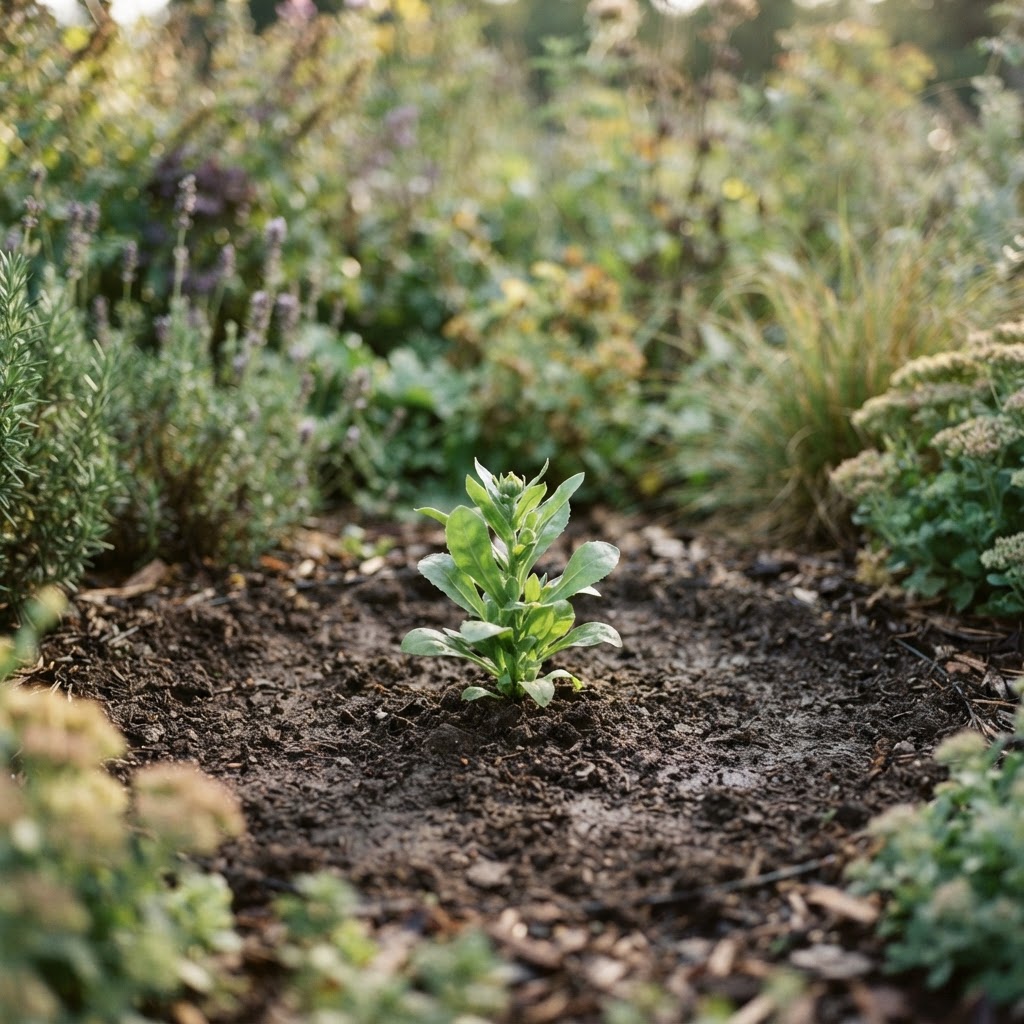
If the problem is perceptual rather than practical, the fix isn't to power through the task list anyway — that just asks an already-depleted mind to do more of the exact thing it's struggling with. The more useful move is to stop trying to assess the garden as a set of jobs at all, at least for a few minutes, and simply look at it instead.
Walk slowly through the space — even just a few steps counts — with no agenda beyond noticing. Find three things that are growing, or thriving, or simply still alive, entirely without your help. A self-seeded flower in a crack. New growth on a rose you haven't touched in weeks. Moss quietly doing its own thing on an old pot. None of this fixes anything or ticks anything off. What it does is give your mind a much smaller, calmer thing to focus on than "the whole garden," which is usually enough to break the all-at-once perception that made everything feel unmanageable in the first place.
Separating the feeling from the facts
It's worth naming the actual gap directly, because it's easy to let overwhelm slide into guilt: you have not failed the garden. You have simply been busy. Those are not the same thing, however similar they feel from the kitchen window on a hard day. A garden that looks overwhelming to a tired mind is not the same as a garden that has genuinely deteriorated — and most of the time, once you've had a minute to actually look rather than assess, what's really there turns out to be considerably smaller and more manageable than the first sweeping impression suggested.
The next time the garden looks like an emergency, it's worth pausing on that word "looks." It's telling you something real about your own state of mind. It's rarely telling you the truth about the garden itself.
This week: look before you decide anything
Next time you catch yourself feeling overwhelmed by the garden, resist the urge to immediately start listing what needs doing. Instead, walk through it slowly for two or three minutes with no task in mind, and find three things that are alive and doing well without your help. Only once you've done that, decide whether there's anything small worth doing today. Most days, there will be — and it will be far smaller than the first glance suggested.
If overwhelm is a pattern you recognise, our Mood-to-Ritual Map card offers a gentle way to meet whatever you're feeling with the smallest useful next step, whatever that turns out to be.