What a 60-Year Garden Taught Me About Starting Small
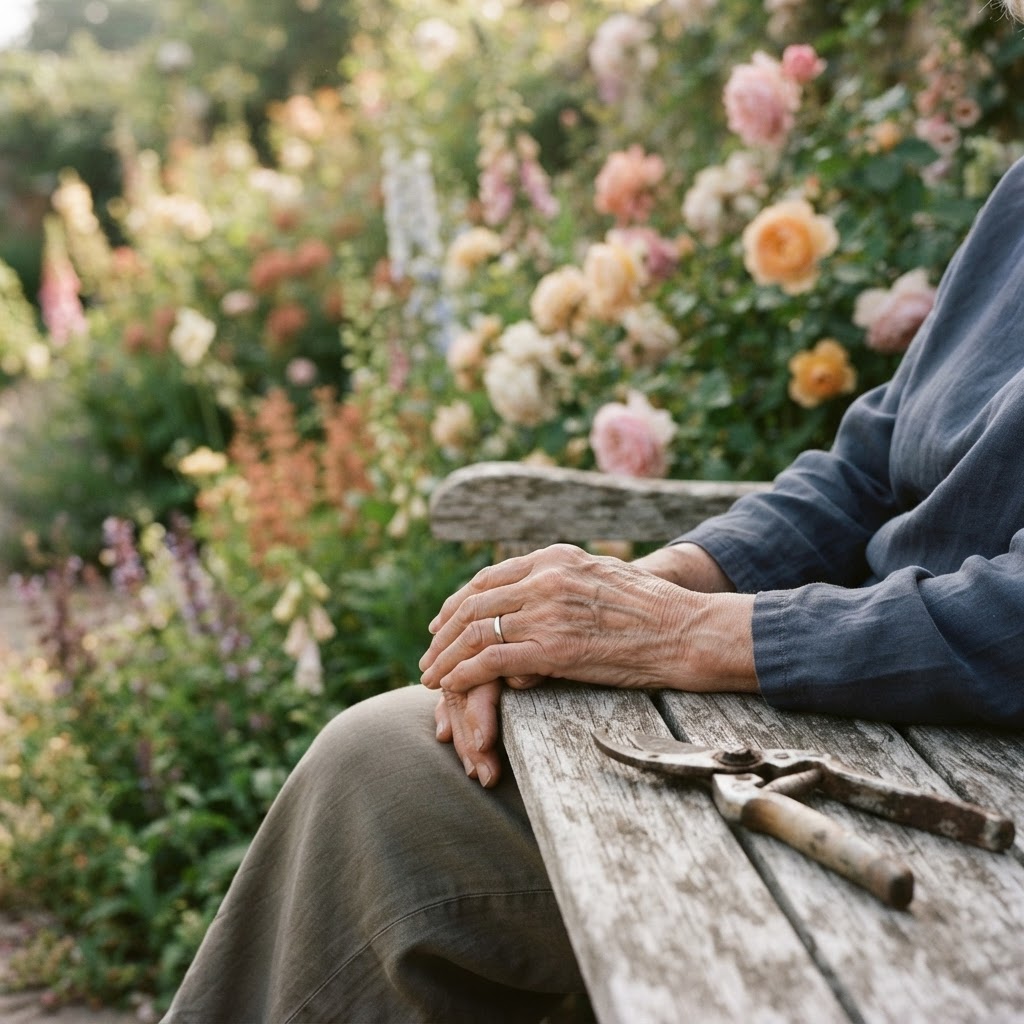
Margaret was eighty-two, and her hands told stories the rest of her rarely mentioned. I'd been admiring her garden for months before I finally worked up the nerve to ask her about it properly. The roses bloomed in perfect succession from early summer right through to autumn. The mixed borders looked effortlessly abundant, never staged, never fussed over, simply right. There was a particular kind of peace that settled over you the moment you stepped through her weathered oak gate, the sort of peace that usually takes decades to build and rarely gets explained.
So I asked her. I expected to hear about complicated feeding schedules, or some piece of arcane horticultural knowledge passed down and refined over sixty years of trial and error. Instead, she laughed. A real laugh, the kind that comes from somewhere deep and doesn't care how it looks.
"Ten minutes," she said, settling into her worn teak bench, positioned just so to catch the morning light through her old apple tree. "Every morning with my tea. I just pay attention."
The Question I Should Never Have Asked
I must have looked sceptical, because she smiled again, her eyes crinkling with the particular patience of someone who has watched a lot of younger gardeners make things harder than they ever needed to be.
"You think it should be harder, don't you? That's the problem with you young ones. You think suffering equals success."
She was right, and it took me a moment to admit it, even to myself. I'd spent years believing, without ever quite examining the belief, that a beautiful garden required sacrifice. That joy had to be earned through exhaustion. That if I wasn't tired and slightly resentful by Sunday evening, I hadn't really gardened at all.
Sitting in Margaret's garden that morning, watching the light move through the apple tree and the roses opening in the early warmth, something I'd forgotten came back to me: the best things often come not from force, but from attention.
This is a lesson worth sitting with if you're standing at the start of something, whether that's a brand new garden, a plot you've just inherited, or a space you gave up on years ago and are only now working up the courage to look at again. Because the question underneath "how do I get a beautiful garden" is very often a quieter, more anxious question: is it too late for me to start this properly?
Margaret's sixty years say, gently and without any drama, that it isn't.
You Think Suffering Equals Success
The story most of us absorbed about gardening, in one form or another, over many years, goes something like this. Real gardeners give up their weekends. A beautiful outdoor space demands sacrifice. If your borders are untidy, it says something about you as a person. Any break in the routine leads to ruin. The people whose gardens look like the photographs are simply more disciplined, more committed, more worthy than the rest of us.
These ideas aren't just unhelpful. They're simply false, and yet most of us took them in so thoroughly that a neglected border can trigger something close to the guilt we'd feel over a neglected friendship.
Margaret never believed any of it, not for a single one of her sixty years in that garden. She never treated it as a performance for anyone else's benefit. She showed up, every morning, with her tea, and paid attention. That was the whole method. There was no dramatic origin story, no year of gruelling effort that finally paid off. There was only a very long series of ordinary mornings, each one small, each one enough on its own.
It Wasn't Magic, It Was Arithmetic
Here's the part of Margaret's garden that genuinely surprised me, because it wasn't mystical at all. It was mathematics.
By early spring, her garden already seemed to look after itself. By midsummer, when her neighbours were hauling barrows of weeds out of borders that had gone untended since May, her paths stayed clean and her roses kept thriving. It wasn't magic. It was arithmetic, plain and almost boring once you see it clearly.
Daily deadheading redirects a plant's energy into producing new blooms rather than setting seed. A weed pulled the moment it's a seedling takes seconds; the same weed left for a fortnight becomes an afternoon's project. A container noticed dry on a warm morning gets watered and survives; the same container noticed three days later has already suffered, sometimes past saving. Ten minutes a day catches these small, easily missed things. A monthly marathon session almost never does, because by the time you get to it, the small problems have already become bigger ones.
The numbers themselves are worth knowing. Ten minutes a day adds up to more than sixty hours across a year. A dedicated Saturday session every single week totals well over two hundred hours, and yet most of those hours end up spent undoing what accumulated in the gaps between sessions. The daily gardener never really falls behind, because there's nothing significant left to catch up on. It isn't that Margaret worked harder than her neighbours. She simply never let the gap open in the first place.
What Sixty Years of Ten Minutes Actually Looks Like
It's worth being honest about what this means, because it isn't a quick fix or a clever shortcut. Margaret's garden is the compound result of roughly sixty hours a year, repeated across sixty years. That's not nothing. But it's also not the exhausting, weekend-devouring commitment most of us assume a garden like hers must have demanded.
What sixty years of ten minutes actually looks like, from the inside, is not a person working tirelessly towards a distant, impressive goal. It's a person having a quiet cup of tea outside most mornings, noticing what's changed since yesterday, and occasionally doing one small thing about it. Multiply that ordinary, unremarkable morning by twenty thousand or so, and you get a sixty-year garden. There was no single dramatic turning point. There was only consistency, held gently, for a very long time.
This matters enormously if you're standing at the beginning of your own garden, wherever that beginning happens to be in your life, and feeling as though you've already missed your chance.
It's Never Too Late to Start Small
Whatever version of "too late" you're carrying, it's worth setting down, at least long enough to read the next few paragraphs.
Starting Small When You've Never Gardened Before
If you've never gardened at all, the idea of Margaret's sixty years can feel intimidating rather than encouraging, as though she's proof of a head start you'll never catch up to. But look again at what actually built that garden: not expertise she arrived with, but attention paid consistently over time. You don't need sixty years of accumulated knowledge to begin. You need ten minutes today, and the willingness to notice what you find. The knowledge accumulates on its own, the way it did for her, simply by showing up.
Starting Small After Years of Neglect
If you're looking at a garden that's been neglected for months or years, the temptation is to see the whole overgrown mess as evidence that you've failed already, before you've even begun. It isn't. A neglected garden is not a garden lost. It's a garden that's been resting, in its own rough way, and is still entirely capable of responding to attention. You don't need to reclaim it all at once, and trying to will likely exhaust you before you've made much of a dent. Choose one small area, give it ten honest minutes, and let the rest wait its turn.
Starting Small Later in Life
If you're starting later in life, whether that's your fifties, seventies, or beyond, Margaret's own story is the most direct answer available. She was eighty-two when we spoke, still tending her garden every morning, still finding it worth doing. A garden doesn't require decades of remaining time to be worth beginning. It only asks for today's ten minutes, and then tomorrow's. Whatever years you have left to give it, it will use them well, and it will give something back for every single one of them.
The Garden Doesn't Care How Long You've Waited
There's something quietly generous about a garden that most people never quite realise until they've experienced it directly: it doesn't keep score of how long you took to arrive. Soil doesn't remember your hesitation. Plants don't hold a grudge about the years you spent meaning to start. The garden simply meets you where you are, on the morning you finally step outside, exactly as readily as it would have met you a decade earlier.
This is worth remembering the next time the thought arrives, as it does for almost everyone at some point, that it's too late, that other people started earlier and have too much of a head start, that your own garden's best years are somehow already behind it before they've begun. None of that is how gardens actually work. A border planted today is not a lesser border for having waited. It's simply a border at the start of its own story, exactly as Margaret's was, sixty years before the version I first saw.
Your First Ten Minutes, Starting Today
If Margaret's example has stirred something in you, here's the simplest possible way to begin, today, without waiting for the right weekend or the right season or the right amount of confidence.
Step outside. Take your tea or coffee with you if that helps. Don't reach for a task straight away. Simply look at what's there, the way Margaret looked at her garden every single morning for sixty years. Notice one thing that's changed, or one small thing that could use a little care. Do that one thing, slowly, without rushing towards anything else. Then stop, look at what you've done, however modest, and let yourself notice it properly before you go back inside.
That's the whole practice. It was Margaret's whole practice too, repeated across two decades and worth, by the time I met her, an entire sixty-year garden. Yours begins exactly the same way hers did: with one ordinary morning, and the decision to pay attention.
Frequently Asked Questions
Is it really possible to build a garden like Margaret's starting from nothing?
Yes, though it's worth being honest that it takes time, the same way it took Margaret time. What her story actually demonstrates is that the time doesn't need to be spent in long, exhausting sessions. Ten minutes a day, held consistently, is what produced sixty years of results. There's no shortcut past the years themselves, but there's also no need for anything more demanding than ten minutes within each of those years.
I'm starting later in life. Is it worth beginning a garden project that might take years to mature?
Almost always, yes. A garden gives something back from the very first season, long before it reaches full maturity, and every year you give it adds to what it offers you in return. Margaret was still finding daily pleasure in her garden at eighty-two, decades after she'd have been able to call it "finished" by anyone's measure. A garden doesn't need to be complete to be worthwhile.
My garden has been neglected for years. Where do I even start?
Start smaller than feels reasonable. Choose one visible area, perhaps the part you see most often from a window or doorway, and give it ten minutes of genuine attention. Resist the urge to tackle the whole space at once. A garden that's had years of neglect rarely needs a single heroic weekend so much as it needs a long run of small, consistent visits.
How long before I'll see results if I only spend ten minutes a day?
Many people notice small changes within the first few weeks, a tidier patch here, a healthier container there, and the more meaningful shift, a garden that genuinely feels cared for, tends to build over a season or two. The sixty-hour-a-year mathematics work the same way for a new gardener as they did for Margaret. The results simply need the days to add up.
What if I miss days, especially at the start when the habit isn't established yet?
That's completely normal, and it doesn't undo anything you've already built. Margaret's sixty years weren't sixty years without a single missed morning. They were sixty years of returning, again and again, without treating a gap as a failure. Simply come back the next day and carry on.
Do I need any particular skill or knowledge to start this way?
No. Margaret's method was paying attention, not accumulated expertise. Knowledge tends to build naturally through the noticing itself, the same way it did for her over six decades. You don't need to know your garden before you start. You get to know it precisely by starting.
Margaret is proof that a beautiful, mature, deeply loved garden isn't the result of talent, luck, or an early start. It's the result of a great many ordinary mornings, each one small, each one enough. Yours can begin exactly the same way, whenever you're ready. Today would do nicely.
Your Garden Friend