The Surprisingly Powerful Habit of Deadheading One Flower
Some days, the garden asks for more than you have to give. You're tired, or the to-do list is already too long, or you've simply lost the will to face whatever's waiting out there. On days like that, the instinct is usually to skip it entirely. If you can't do it properly — a proper weed, a proper tidy, the whole border sorted — what's the point of doing anything at all?
Here's a smaller, better question worth trying instead: what if you just deadheaded one flower?
It sounds almost too small to matter. That's rather the point, and it's also exactly why it works.
When "nothing" feels like the only option
All-or-nothing thinking is one of the quieter ways gardening becomes a source of guilt rather than pleasure. If today's version of gardening has to look like yesterday's — a proper session, a real dent in the task list — then a day with low energy or little time doesn't get a smaller version of the ritual. It just gets skipped. And a skipped day easily becomes two, then a week, until the whole practice has quietly stopped without anyone deciding to stop it.
The mistake here isn't laziness. It's the assumption that a task only counts if it's substantial. Once that assumption takes hold, the smallest, most sustainable version of gardening — the version that would have actually got you outside on a hard day — gets ruled out before it's even considered.
The science of one small thing
There's real research behind why the tiny version works so well, and it's worth knowing because it changes how you see the small stuff. Making meaningful progress, even in genuinely small amounts, is one of the most consistent drivers of positive emotion that psychologists have found — a finding that comes from workplace studies by Teresa Amabile and Steven Kramer at Harvard, but which applies just as neatly to a border as it does to a project at work. The brain doesn't grade progress on a curve based on how big the task was. It registers something moved forward, and it responds to that signal roughly the same way whether the task took ten seconds or ten hours.
That means a single deadheaded rose isn't a diminished, consolation-prize version of "real" gardening. It's a complete instance of the exact mechanism that makes gardening feel good in the first place — proof of progress, however small, that your mood and motivation respond to directly.
Why your brain doesn't care how big the task was
This is worth sitting with, because it runs against most of what we're taught about achievement. We tend to assume satisfaction has to be earned in proportion to effort — that a huge task deserves a huge sense of accomplishment and a tiny one barely counts. But the progress principle suggests something more forgiving: what actually drives the good feeling is the fact of forward movement, not its scale. One flower, properly attended to, genuinely counts.
What one flower actually does
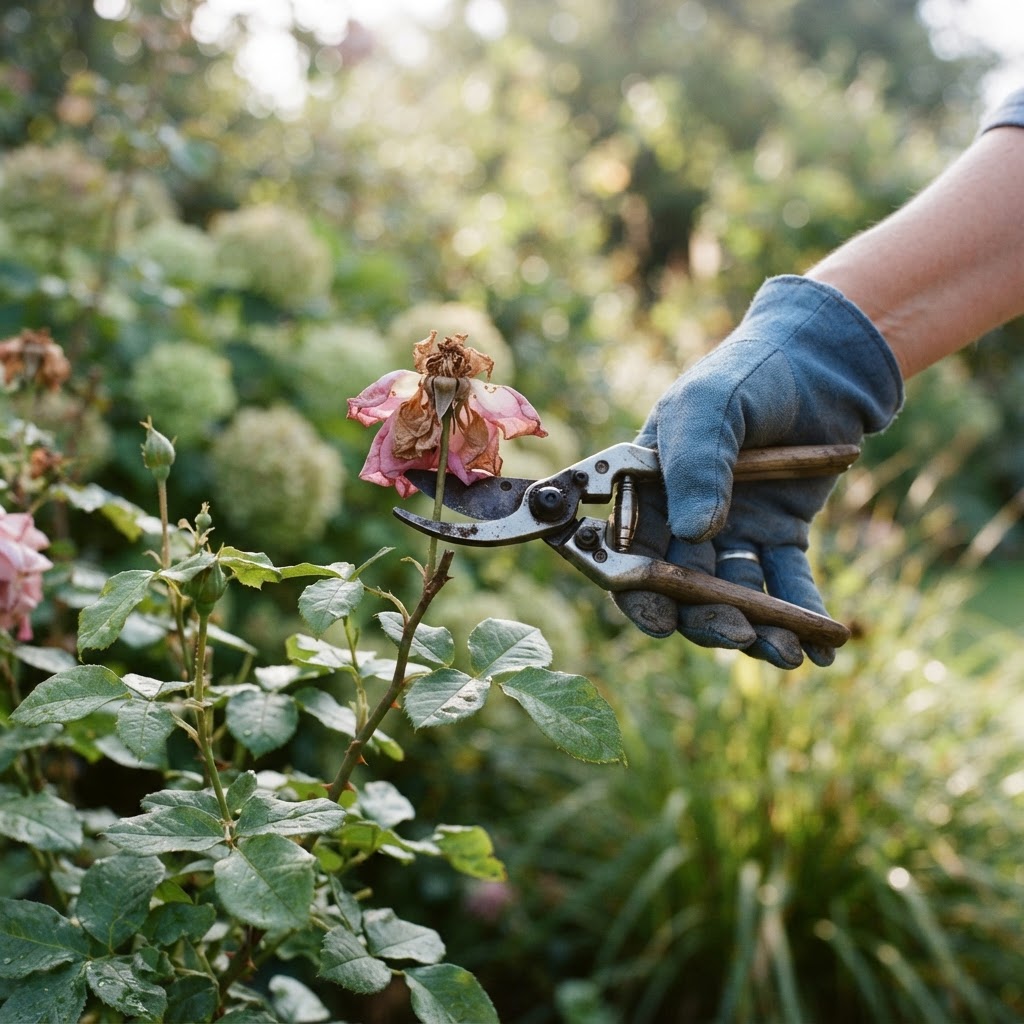
Deadheading is a good place to put this into practice, because it's about as low-friction as gardening gets. No tools are strictly required — fingers will do, though secateurs make a cleaner job of it. Find one spent bloom. Remove it. Notice the plant looks slightly better for it. That's the whole task, start to finish, in under a minute.
What makes it more than just tidying is what it leaves behind: a small, visible, undeniable piece of evidence that you showed up and did something. Not a vague sense that you "should get round to the garden soon," but an actual, physical fact — this flower, gone, because you dealt with it. On the days when everything else feels too large to start, that one small fact is often enough to shift the whole tone of how you feel about the garden, and about yourself in it.
How tiny actions compound
None of this stays contained to a single moment, either. A rose deadheaded today doesn't just feel good in the moment — it's also one small piece of evidence, repeated often enough, that starts to change how you think of yourself. Not "someone who's meant to garden more" but someone who actually, reliably, shows up — even if what showing up looks like on a given day is just one flower.
Over time, that repeated small evidence does something quieter and more lasting than any single session could. The ritual stops feeling like a task you're managing to keep up with and starts becoming simply part of who you are — the kind of shift that happens gradually, through dozens of small completed acts, rather than through one dramatic turnaround. You don't notice it changing day to day. You notice, eventually, that it already has.
This is also why deadheading specifically tends to work better than other tiny tasks on the hardest days. Pulling one weed is useful, but it's easy to see a single weed and immediately notice the twenty still waiting behind it. Deadheading doesn't invite that comparison in the same way — a spent bloom removed is simply finished, complete, with nothing further demanding your attention the moment you're done. It's a task with a natural, satisfying edge to it, which matters more than it sounds like it should when you're looking for the smallest possible reason to go outside.
When it's tempting to do more
Some days, deadheading one flower will lead naturally into deadheading three or four more, and that's perfectly fine — the point was never to impose an artificial ceiling on a session that's going well. What matters is that the one flower was never conditional on the rest following. If the fifth bloom doesn't happen today, the first four still counted in full. Letting a good day extend itself is different from needing every day to extend itself before it's allowed to count, and it's worth noticing which of the two you're doing.
This week: deadhead one flower and stop there
Next time you're too tired, too busy, or too guilty to face "proper" gardening, try the smallest version instead. Go outside, find one flower that's finished blooming, and deadhead it. Then stop. Don't let it turn into a bigger session unless you genuinely want it to. The point isn't to trick yourself into doing more — it's to prove, in under a minute, that showing up doesn't require much at all.
That one small, completed thing is not a lesser version of gardening. It's the whole practice, working exactly as it's meant to.
If low-energy days are where your ritual tends to slip, our Your First Ten Minutes starter kit walks through the smallest possible version for exactly those moments — including the two-minute option for when even one flower feels like a stretch.