The Harvest Is the Gardener: What Five Years of Ten Minutes a Day Actually Builds
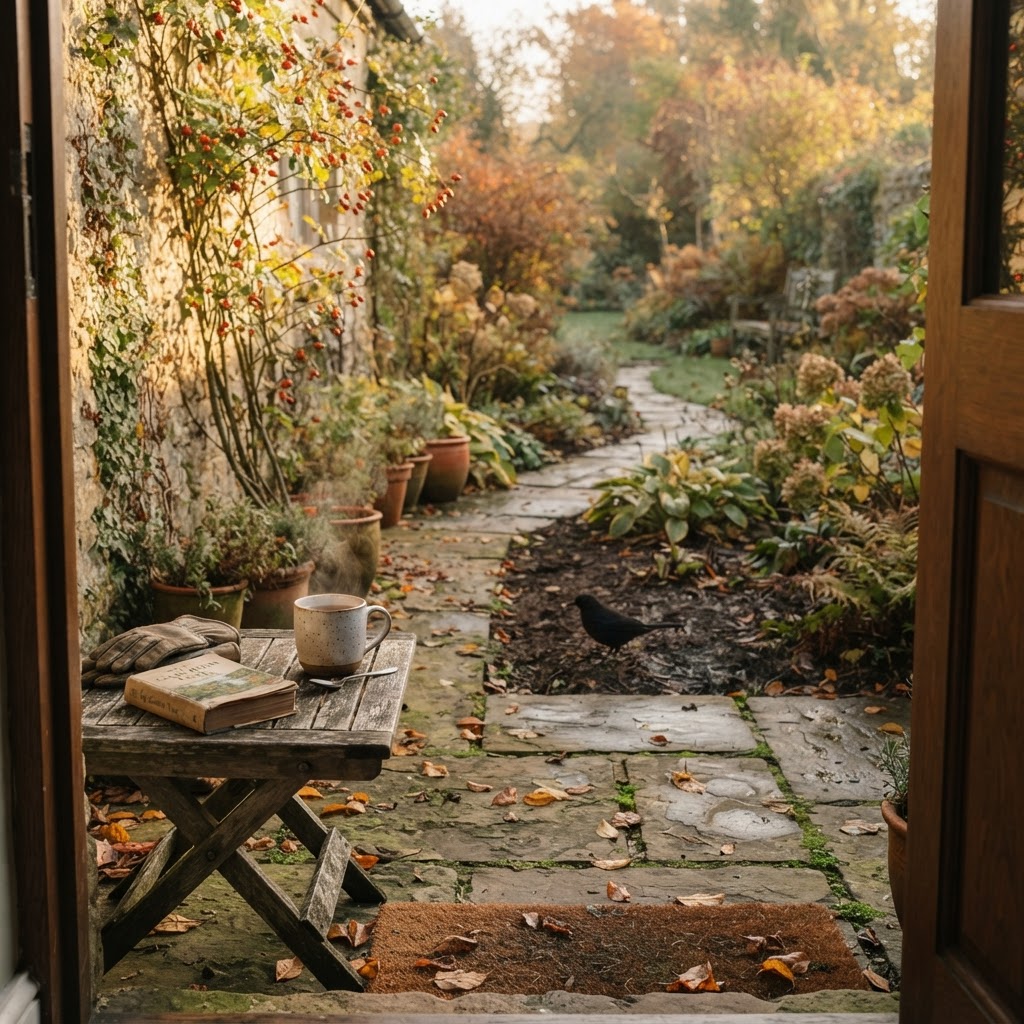
Picture someone standing in their garden on a crisp autumn morning, cardigan pulled close against the cold, a mug of tea cooling in one hand. They're not doing anything in particular. Just standing there, entirely at ease in a space they've tended and watched and come to know over years. The climbing rose behind them has put on new growth since yesterday, and they noticed it the moment they stepped outside, the way you'd notice a familiar friend had changed their hair. A blackbird works the same corner of the border it returns to every autumn. The light at this hour, in October, falls in a way this person has learned to love.
Five years earlier, this same person might have stood at a kitchen window instead, coffee in hand, cataloguing everything wrong with the view outside rather than noticing what was right with it. The garden felt like a weight then, something they were failing at rather than something they belonged to.
What changed between those two mornings wasn't the weather, or luck, or a sudden windfall of free time. It was ten minutes a day, shown up for consistently, over a long enough stretch of time for something genuinely different to grow. Not just in the garden. In the person standing in it.
The Garden Will Still Have Weeds
Here's the part of this story most people don't expect, and it's worth saying plainly before anything else. Five years of daily ten-minute rituals will not produce a flawless garden. There will still be jobs waiting to be done. There will still be plants that surprise you and plans that didn't quite work out. A border you were convinced would look magnificent by the third summer might take until the fourth to properly find its shape. A climber you genuinely loved might quietly die one winter, leaving a gap that takes a whole season to forgive.
None of this will feel like failure, and that distinction is the entire point of everything this practice has been building towards. Five years of daily ten-minute rituals will have changed not what your garden looks like on its very best day, but what your garden feels like on an entirely ordinary Tuesday. That's a different, and in many ways far more valuable, kind of transformation than a picture-perfect border ever could be.
What Five Years of Ten Minutes Actually Adds Up To
The arithmetic is worth revisiting here, because it looks different stretched across years rather than a single season. Ten minutes a day comes to somewhere over sixty hours across a single year. Multiply that across five years and you're looking at several hundred hours of genuine, attentive presence in one place, spent not in exhausting bursts but in small, sustainable increments that never once demanded a whole weekend or left you collapsed and behind afterwards.
But the raw hours were never really the point, and by this stage in the practice, that becomes obvious. What matters is what showing up consistently does, both to a garden and to the person tending it, that occasional intensive effort simply cannot replicate. Plants respond to regular attention in ways they never respond to sporadic bursts of it. Small problems get caught while they're still small, year after year, so nothing ever has the chance to accumulate into the kind of overwhelming backlog that used to define a neglected garden. And your relationship with the space itself shifts entirely over that time, from something you assess and judge to something you simply notice, the way you'd notice a change in a person you see every day.
How the Relationship Deepens Across Years
A garden changes you, but slowly, and mostly in ways you don't notice while they're happening. It's usually only in retrospect that the shifts become clear at all.
Year One: Building the Ritual
In the early months, the work is largely conscious. You remind yourself to go outside. You think about what to do before doing it. The ritual is something you're actively building, rather than something you simply inhabit, and the effort of that building tends to be the main thing you feel during this stretch. This is entirely normal, and it doesn't mean anything has gone wrong. Every lasting habit passes through this stage before it becomes anything easier.
Years Two and Three: Beginning to Know Your Garden
Somewhere around the second half of the first year, and deepening through the second and third, something genuinely shifts. The ritual begins happening because you're already outside, rather than because you've consciously decided to go. You start to understand your particular garden's personality: which areas thrive on a little neglect, which plants respond most generously to daily attention, how your specific patch of ground differs from the general seasonal advice written for somewhere else entirely. This is the real beginning of knowing your garden, which is a genuinely different thing from simply knowing about gardening.
Years Four and Five: Fluency
By the fourth and fifth years, the relationship tends to deepen into something closer to fluency. Subtler signals become legible in a way they weren't before: the particular way light shifts in late summer, how a plant starts to look just before it actually needs something, the barely perceptible stirring of spring growth weeks before anything becomes visible to a less practised eye. You begin to anticipate the garden's needs rather than simply respond to them after the fact. This is what it means to learn a garden's particular language, rather than following a generic instruction manual written for no garden in particular.
The Real Harvest Isn't in the Soil
There's a reframing worth sitting with properly, because it changes what "success" even means in this whole practice. Perhaps the most valuable harvest of all isn't found in the garden at all. It's found in the person who tends it.
This isn't a poetic flourish so much as an honest description of what actually seems to happen over years of this kind of attention. The capacity to be still for ten minutes and genuinely notice what's there, not planning the rest of the day, not reviewing what went wrong yesterday, simply being present in one place with one set of living things, watching what they're doing, doesn't stay contained to the garden. It travels. It shows up in a difficult conversation handled with a little more patience than it might once have been. It shows up in a work problem approached with steadier attention, less panic, more willingness to trust a process rather than force an outcome.
Spending years making small horticultural mistakes in a space that forgives them readily also tends to make a person less frightened of mistakes elsewhere. A plant that dies isn't a catastrophe. A border that takes longer than expected to find its shape isn't a failure. Those lessons, learned quietly and repeatedly in the safest possible setting, tend to soften how a person relates to mistakes more broadly, in work, in relationships, in anything that takes longer than hoped to come good.
What the Conversation Teaches
By this point, the garden has stopped being something you're failing at and become, instead, something you're in ongoing conversation with, seasonal and never quite finished, available to you every morning for the rest of your life.
That conversation teaches things slowly, through sheer repetition rather than instruction. It teaches patience, through plants that grow at their own pace regardless of yours. It teaches acceptance, through winters that are simply winters, not failures or endings, but necessary rest built into the shape of every year. It teaches trust, through springs that always come, through the climbing rose that looks entirely dead in February and magnificent again by June, through the border that took three full years to find its shape and now looks as though it always knew exactly what it was doing.
And underneath all of that, it teaches you to notice. Ten minutes a day, sustained across years, adds up to an enormous amount of time spent looking at one place with real attention and no particular agenda. Not planning, not reviewing, not performing or optimising or trying to improve anything in particular. Simply being somewhere real, with living things, paying the kind of attention that so little else in a busy life ever asks of you.
The Practice That Doesn't Stay in the Garden
If there are children in the house, they tend to absorb something from watching a parent tend a garden consistently that can't really be taught directly through instruction. They learn, simply by observing it repeated over years, that showing up for something, day after day, with care and without drama, is how the most worthwhile things actually get built. That lesson travels a great deal further than the garden gate ever did.
Something similar tends to happen in a wider community too, quietly and without any deliberate effort on your part, because other people notice what consistent attention produces over time. A neighbour asks about a particular plant. A friend wants to understand how the containers keep looking so good through the whole season. A colleague mentions, almost in passing, that they've started stepping outside in the mornings themselves, because they remembered you once saying it helped. None of this needs to be sought out. It tends to happen naturally, simply as a byproduct of a practice lived consistently and visibly over years.
Sharing What You've Learned
At this stage in the practice, it's worth deliberately taking stock of how your relationship with your garden has already evolved since you began. Notice where the journey now feels entirely natural, and where, honestly, it still feels a little effortful. Notice where you feel genuinely ready for something deeper, not as a plan you need to execute, but simply as an honest observation about where your own curiosity is already pointing you.
It's also worth trying, at least once, to share some of what you've learned with someone else. Explaining the zone approach to a neighbour. Giving away a plant that's outgrown its spot. Simply pointing a friend towards the evening ritual when they mention feeling frazzled at the end of a long day. The practice of putting what you know into words for someone else is, in itself, one of the most reliable ways of understanding it more fully yourself.
Taking Stock: Where You Are Now
Wherever you currently are in this practice, whether you're reading this on day one, week three, or five years in, it's worth pausing to notice honestly where you actually stand, rather than where you think you're supposed to be by now.
If you're near the beginning, know that the effort you're feeling right now is entirely expected, and that ease genuinely does arrive later, usually somewhere around the two-month mark, provided you keep gently returning after the inevitable missed days. If you're a year or two in, notice whether the ritual has started to feel automatic yet, something you do before you've quite decided to, the way you might put the kettle on without thinking about it. And if you're further along still, it's worth simply noticing what's changed in you, not just in the borders, over the years you've been showing up.
Welcome Home
This whole practice began, for a great many people, with someone standing at a kitchen window, carrying real guilt about a garden they loved and somehow couldn't quite manage. It doesn't have to end there, and for those who keep returning, it generally doesn't.
Not because the garden becomes perfect. Not because every problem gets solved or every technique gets mastered. But because the relationship between the gardener and the garden changes, fundamentally, from something you're failing at into something you're simply in conversation with. An ongoing, seasonal, never quite finished conversation, available to you every single morning for the rest of your life, in whatever ten minutes the day can spare.
Your garden isn't waiting somewhere in an imagined future, once you finally have more time, more knowledge, or more energy than you currently do. It isn't dependent on perfect weather, ideal conditions, or expensive tools you don't yet own. It's waiting for you right now, in the next ten minutes you can spare. In the single plant you can water with real attention. In the one small corner you can clear with genuine care. In the simple moment of stepping outside and noticing what's already growing there, already trying, already reaching quietly towards the light, entirely without needing your permission to do so.
The only real question left is whether you're ready to answer.
Frequently Asked Questions
Is it really possible for a ten-minute daily habit to change something as significant as how I handle stress or difficulty?
Many people report exactly this kind of shift over a year or more of consistent practice, though it's worth being honest that it's difficult to prove any single habit is solely responsible for a change like this. What can be said fairly is that regular time spent in unhurried, attentive contact with something living is genuinely associated with improvements in mood and stress, and the patience a garden teaches does tend to carry into other parts of life for a great many people.
How do I know if I'm actually making progress, if the garden still looks imperfect after years of effort?
Progress in this practice was never meant to be measured purely by how flawless the garden looks. A more reliable marker is how the garden feels to you on an ordinary day, whether stepping outside has become something you look forward to rather than dread, and whether the old guilt has genuinely quietened, even if a few weeds remain.
What if I've only just started and five years feels impossibly far away?
That's completely understandable, and it's worth not thinking about the full five years at all in the beginning. Focus entirely on today's ten minutes, and let the years take care of themselves. Every long-term gardener who's reached genuine fluency started with exactly the same single, ordinary first morning you're standing at now.
Does the garden ever stop needing daily attention once it's more established?
Not entirely, though established plantings, particularly in Zones 2 and 3, do tend to become more self-sufficient over time. The daily ten minutes remains valuable even in a mature garden, not because the garden couldn't survive without it, but because the ritual itself continues to offer something valuable to the person doing it.
Is it normal for the practice to feel different after several years than it did at the start?
Yes, and this shift is one of the clearest signs that the practice has genuinely taken root. Where it once felt like a discipline you were building, it tends to become something closer to a natural rhythm you simply inhabit, similar to how making a morning cup of tea stops feeling like a task at some point and just becomes part of how the day begins.
What should I do if I've lapsed for a long stretch, even after years of consistent practice?
Exactly what you'd do after any shorter lapse: return the next morning, without turning the gap into a verdict on the years that came before it. Even years of established practice can survive a genuine pause. The garden will be waiting, and so will the version of this practice you built before the gap, ready to be picked back up rather than started over from nothing.
Ten minutes. Step outside. That's all it ever takes to begin, and it's all it will ever take to begin again, however long it's been.
Welcome home.
Your Garden Friend, Alex