The Evening Garden Reset: Five Small Rituals for the End of the Day
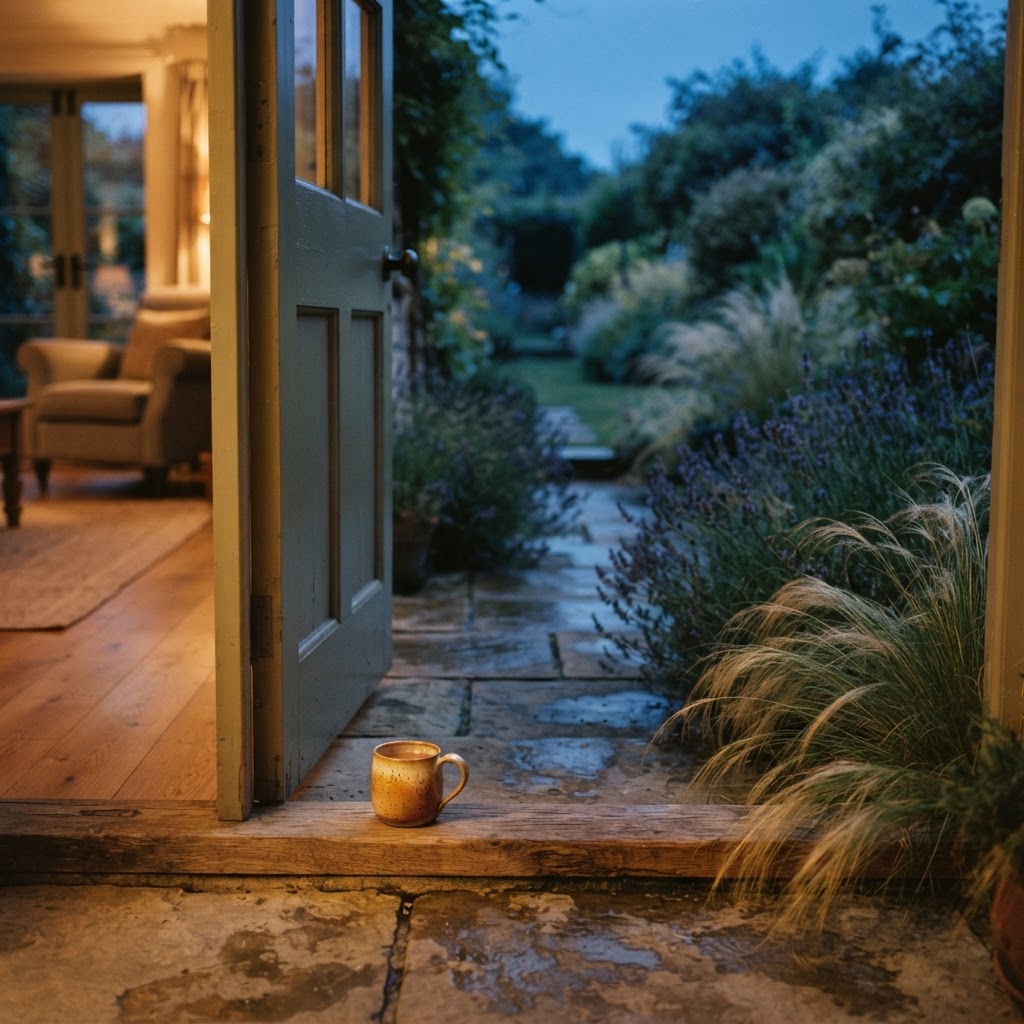
It's 6:47 in the evening. You've been home for twenty minutes, but you're not quite here yet. You changed out of your work clothes. You put the kettle on. You opened your phone to check one thing and, somehow, fifteen minutes passed. The garden is visible through the back door, you can see it from where you're standing, and somewhere underneath the tiredness there's a faint pull towards it. Not the urgent pull of something that needs doing. Something quieter than that.
Then the kettle boils. Someone needs something. The moment passes, the way it usually does.
This is for that moment, the one that keeps almost happening. It's about what becomes possible if you give yourself permission to step outside, not to work, not to fix anything, not to make the garden presentable for anyone. Just to arrive in it. For ten minutes. At the end of the day.
Why Evening Is When the Garden Earns Its Keep
Most gardening advice treats the garden as a morning or weekend activity, and there's something genuinely lovely about an early start, dew still on the grass, the day not yet asking anything of you. But for a great many people, mornings are rushed. School runs, commutes, a laptop open before the coffee's even finished. A ten-minute morning ritual is worth building, and it works beautifully for plenty of people, but evening offers something different.
Evening has its own particular quality. The light turns golden. Scent lifts from warm soil as the temperature starts to drop. Birds settle into the trees with a different kind of noise, not the busy chatter of morning but something more ruminative, winding down for the day. Your garden at seven in the evening looks different from your garden at seven in the morning. Softer. More forgiving.
You're different too, by that point in the day. Not necessarily better; by evening most of us are tired, a little flat, overstimulated in that particular way too many decisions and too many screens tends to produce. But there's an openness in that tiredness. The guard is down. The striving has quietened somewhat. Without choosing it, you're often more receptive than you were first thing that morning. The garden doesn't need you at your best.
There's a practical reason evening matters too. It's the transition point between the working day and the evening, between your work self and your home self, between reacting to things and finally resting from them. Most of us navigate that transition by scrolling, giving our already depleted attention to something that asks nothing of it but somehow takes up all the space anyway. The garden offers a genuinely different kind of transition, one that happens in your body rather than on a screen.
What These Rituals Are (and Are Not)
It's worth being clear about what follows, because these five options are easy to mistake for a slightly rebranded chore list. They aren't. They're small, sensory, unhurried acts, designed not to improve the garden particularly, but to help you arrive somewhere quieter inside yourself. Choose one. That's genuinely enough. Ten minutes, once, at the end of the day.
Five Evening Garden Rituals
Each of these takes around ten minutes, though some can be shorter if that's all you have. None require any planning in advance. Pick whichever one matches what you feel like reaching for tonight.
The Slow Watering
Fill the watering can and take it outside. Water one container, or two, or three, whatever feels manageable without needing to plan it out first. Pour slowly. Notice the sound of the water hitting the compost. The change in smell as the soil absorbs it. The plant quietly receiving what it's given. The can becoming lighter in your hand as you go.
The One-Corner Tidy
Choose one small area. The pot by the back door. The edge of the patio. A single corner that's been bothering you in that low-level, background way garden things tend to. Spend ten minutes making just that one area slightly better. Remove a few dead leaves. Pull the two or three most obvious weeds. Deadhead whatever's finished. Not the whole garden. One corner. The satisfaction this produces is disproportionate to the effort involved, and the before and after will be clear enough for you to see, even if nobody else would ever notice the difference. You will notice. That's enough.
The No-Work Sit
Go outside with something warm to drink, and sit down. Do nothing. This is, honestly, the hardest ritual on this list, and quite possibly the most important. It can feel like a waste of time, or something self-indulgent, or something you haven't earned yet. The to-do list is still there. The garden still has weeds. Surely sitting down just makes both of those things worse.
It doesn't. When you sit outside without a purpose, something genuinely shifts. The garden stops being a list of tasks and becomes, simply, a place. A robin that's been watching you from the fence becomes visible. The way late light falls across the lavender becomes something you can actually see, rather than something you pass by in a hurry. The cooler, softer temperature of the evening air becomes something you notice, rather than something that just happens around you unnoticed. None of this asks anything of you except your presence. You don't have to earn this. The garden is one of the few places that makes stillness genuinely easy.
The Deadhead and Breathe
Take your secateurs, or just your fingers for soft-stemmed flowers, and remove the spent blooms from one plant. Just one. The roses by the door, perhaps, or whatever's finished flowering nearby. Deadheading is repetitive in the best possible sense. Snip. Step back slightly. Snip. The rhythm is steady and the action is clear. You're not solving anything or deciding anything. You're simply doing one small thing that will help the plant bloom again.
Breathe while you do it. In through the nose, taking in the smell of the plant up close, the evening air, the soil beneath. Out slowly. Most of us hold our breath slightly when we're concentrating or rushing through something. Deadheading is slow enough that you genuinely can't.
The Herb Touch
Walk to wherever your herbs are, lavender, rosemary, thyme, mint, whichever you happen to have. Run your fingers slowly through the leaves or flowers. Smell your hands. You can do this right at the door, still in your work clothes, in the last of the evening light. You don't need to have properly "gone into the garden" for this one. The garden comes to you instead. Thirty seconds, perhaps a minute. Nothing more is required.
How to Make It Stick: Attaching the Ritual to Something You Already Do
The evening garden reset works best when it's attached to something that already happens in your day, rather than something you have to remember on top of everything else. Not "when I have enough energy," but "after this other thing, I do this next."
Try pairing it with something reliable: after you change out of your work clothes, you step outside for ten minutes. After you start dinner, you water the pots while you wait for something to cook. After the children are settled for the evening, you take your tea outside. After you close your laptop for the day, you spend ten minutes outside before you open your phone. Choose one trigger and one ritual. You're not building an elaborate new evening routine. You're simply inserting one small outside moment into an evening that's already happening anyway.
What You're Really Doing Out There
It's worth being honest about what's actually happening during these ten minutes, because it isn't quite what it looks like on the surface. You're not gardening in the traditional sense. You're not making meaningful horticultural progress, or crossing anything significant off a list, or noticeably improving your outdoor space.
You're doing something a little harder to name, and considerably more important. You're choosing, at the end of a day that's asked a great deal of you, to be somewhere that asks almost nothing back. You're giving yourself ten minutes of something cool and green and entirely unhurried. You're not fixing the garden. You're letting the day loosen its grip. You're arriving back into the evening, properly, rather than half present while your phone quietly claims the rest of your attention. That's not a small thing. In a life as full as most of ours are, ten minutes of genuine presence, not consuming anything, not performing for anyone, not catching up on a single thing, is worth more than it might first appear.
When You Miss an Evening
Some evenings, the ritual simply won't happen, and that's an entirely ordinary part of how real life goes. When that happens, the instruction is straightforward: return the next evening without making the missed one mean anything in particular. You're not behind. You're just a person who had a different kind of Tuesday than you'd planned for. The garden will still be there tomorrow evening, exactly as receptive as it was tonight.
Choosing Tonight's Ritual
If you're not sure which of the five to reach for this evening, it helps to notice, briefly, what you actually have available right now rather than overthinking it. Got a watering can and a couple of thirsty pots? The slow watering is right there. Feeling brave enough to simply sit still for a few minutes? Try the no-work sit. Only have thirty seconds and a herb pot by the door? The herb touch will do the whole job.
There's no wrong choice among the five. Each one is built to do the same essential thing: give you ten quiet minutes, or fewer, at the natural hinge point of your day, without asking anything from you that you don't already have to give.
Frequently Asked Questions
Do I need to do all five evening rituals, or just one?
Just one, and that's genuinely by design. Choose whichever feels most appealing or manageable tonight. There's no requirement to work through the list, and rotating between them simply as your mood or energy shifts is exactly how they're meant to be used.
What if I'm too tired to even step outside in the evening?
That's a completely understandable place to be, and it's worth remembering the evening visit was never required in the first place. It's a gift, not a duty, and on a genuinely exhausted day, skipping it entirely and simply resting is a perfectly valid choice. The morning ritual, if you have one, is enough on its own.
Can I do an evening ritual even if I already did my main ten-minute visit that morning?
Absolutely. Many people find the evening visit a welcome second, smaller moment in the day, entirely separate from the morning's main ritual. It doesn't need to accomplish anything the morning visit didn't already cover.
Is the no-work sit really doing anything, or is it just an excuse to be idle?
It's doing something real, even though it might not look like much from the outside. Sitting outside without a task tends to shift how you perceive the space around you, letting you notice birdsong, light, and temperature in a way that a task-focused visit rarely allows. It isn't idleness. It's a different, equally valid kind of attention.
How do I remember to actually do this most evenings?
Attaching it to something that already happens reliably in your evening, changing clothes, starting dinner, closing your laptop, tends to work far better than simply trying to remember on willpower alone. Choose one dependable trigger and let the ritual follow automatically from it.
What if my garden is very small, just a balcony or a few pots?
Every one of these five rituals works perfectly well at a small scale. The slow watering needs only a single container. The herb touch needs only one pot by a door. Scale has very little to do with whether these rituals work; presence is really the only requirement.
Tonight, at whatever hour the day begins to ease, try one thing. Step outside. Notice the air is a different temperature from indoors. Notice the light has changed since this morning. Notice that the garden, imperfect and unfinished and entirely yours, is simply there, waiting for nothing more than ten quiet minutes of your evening.
Your Garden Friend