Peaceful Versus Pretty: Designing One Corner of Your Garden Just for You
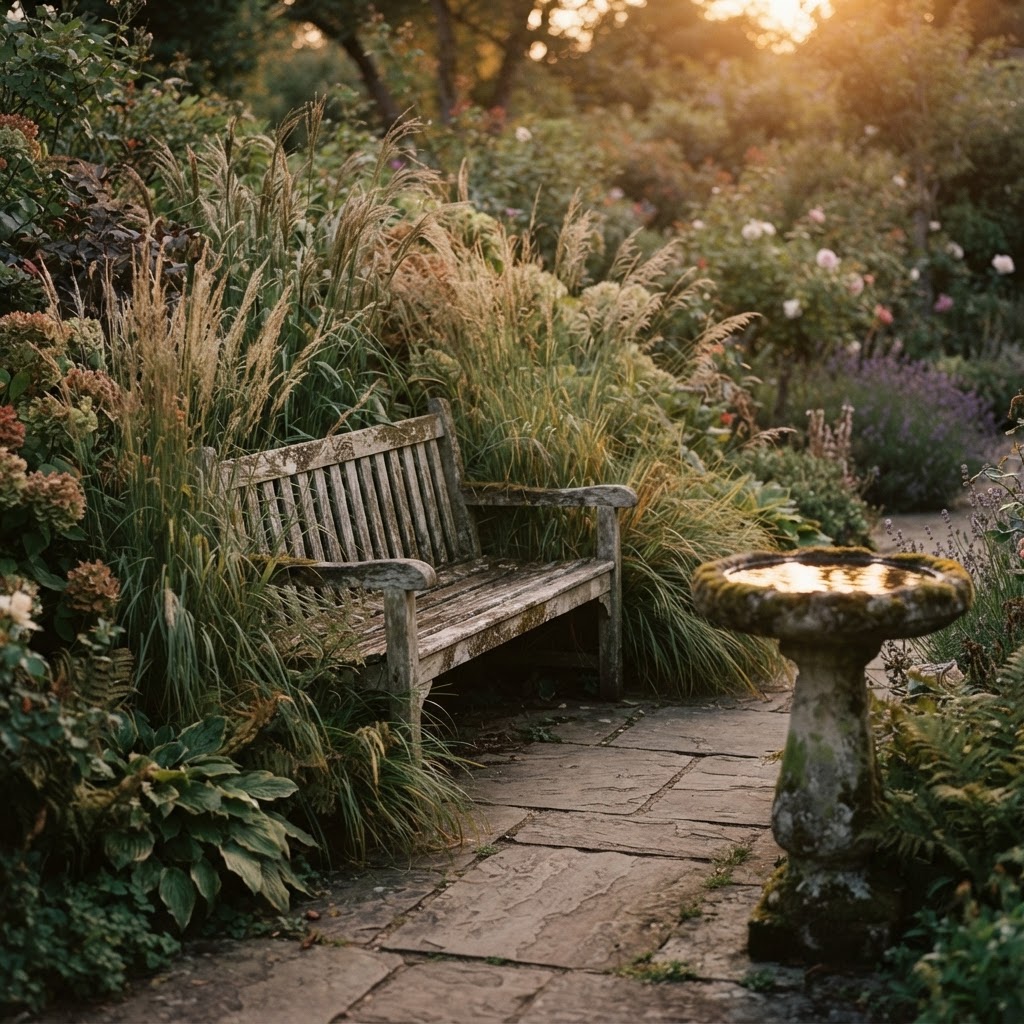
There's a corner that some gardeners find, almost by accident, where they feel different almost immediately upon arriving in it. Nothing dramatic. Perhaps a bench backed by something tall, positioned to catch the evening light. A fragrant plant close enough to brush against on the way past. A small water feature or a bird bath, visited reliably by the same pair of blackbirds. The rest of the garden is visible from that spot, but somehow it feels enclosed rather than exposed, like watching from somewhere genuinely safe.
Most people who have a corner like this didn't design it from any particular theory. They arrived at it gradually, through years of noticing where they naturally drifted when they needed to think, or rest, or simply be somewhere quiet. It's entirely possible to design this kind of space on purpose, though, once you understand what actually makes a garden feel restorative rather than merely attractive.
Pretty Versus Peaceful: The Distinction That Changes Everything
This is worth sitting with properly, because it reorganises almost everything else about how you might think about your garden. Plenty of gardens are genuinely beautiful, admired by visitors, clearly the product of real skill and effort, and still leave their owners permanently anxious. The standard is simply too high to maintain comfortably. The garden has been designed to impress, and it does, but the cost of impressing is a constant low-level dread about letting the standard slip.
A peaceful garden is something fundamentally different. Its beauty serves you, rather than requiring you to serve it.
A pretty garden tends towards clean lines, formal symmetry, and high-maintenance seasonal displays. It's designed to be viewed from a distance, and it rewards the admiring glance, the photograph, the visitor's compliment. What it rarely does is invite you to sit down in it for very long. It doesn't ask you to linger. It asks you to maintain.
A peaceful garden, by contrast, has gentler curves and a more natural flow. Its plants are chosen not just for how they look but for how they feel, smell, and sound. It has intimate spaces that invite sitting and doing nothing in particular. It tolerates imperfection without apology, because it was never really about perfection in the first place. It was about how it feels to be inside it.
A peaceful garden invites you to take your shoes off and sit on the warm paving. To run a hand along a lavender hedge without any particular purpose. To stay in one corner until the light changes, which will take longer than you'd planned, and that will be entirely fine. Most importantly, it makes no demands on you simply by existing. It receives you as you are and asks only that you show up to it occasionally.
What Makes a Space Feel Safe
Think for a moment about the spaces where you've felt most genuinely at ease, whether in a garden or anywhere else. Most people, when they consider it honestly, describe them in similar terms. Something solid at their back. An open view ahead. A sense of being able to see what's coming without feeling too exposed themselves. Not quite hidden, but sheltered. Watching from a place of safety.
There's a long-standing idea in environmental psychology that we're drawn to spaces offering both prospect, the ability to see out, and refuge, the ability to withdraw, because these were roughly the conditions under which people could once rest without needing to stay alert. The finer theoretical points are debated, but the practical observation tends to hold up well in ordinary experience: seating backed by tall planting, with an open view across the rest of the garden, tends to feel considerably more peaceful than seating that's either fully exposed or entirely boxed in. It's worth bearing this in mind when you're deciding where to place a bench or chair.
There's also something worth knowing about attention itself. Researchers have described a quality called soft fascination, the particular way the natural world can hold your attention without demanding much from it. A busy street demands your attention. A screen demands it too. But water moving gently in a shallow basin, or birdsong, or long grass stirring slightly in a late afternoon breeze, these things interest us without taxing us. In that particular state, interested but not effortful, the part of the mind that's been working hard all day genuinely gets to rest.
This is why the sensory qualities of a restful space matter every bit as much as its visual ones. The scent of lavender on warm stone. The sound of water. The texture of bark under your fingertips. These aren't decorative extras. They're how a garden reaches past thought and touches you directly.
A note on wellbeing worth being honest about here: time spent in garden environments is associated, in research, with real benefits for mood, attention, and stress levels, but gardening remains a complementary practice, not a treatment for medical or mental health conditions. If you're experiencing persistent anxiety, depression, or other mental health concerns, it's worth speaking with a qualified professional, alongside anything you build here rather than instead of it.
Finding Your Own Restoration Style
Before any planting, furniture, or design decision, there's a more fundamental question worth asking: what does restoration actually feel like for you, specifically? Not what it's supposed to feel like, or what looks restful in a photograph, but what genuinely settles you.
Restoring Through Gentle Movement
Some people restore through gentle movement and sensory engagement. They need the sound of water, the activity of birds, the slight movement of ornamental grasses in a breeze. Stillness, for these people, can feel uncomfortable rather than calming. The garden that restores them is one that stays quietly alive, always offering something small to notice.
Restoring Through Stillness
Others restore through stillness and simplicity instead. They need a space that asks very little of the eye: calm colours, stable forms, minimal movement. Too much sensory stimulation feels exhausting rather than restorative for this kind of person. A palette of greens, whites, and silvers, plants like hostas, white astilbe, or silver-leaved artemisia, tends to rest the eye rather than stimulate it. Enclosed spaces with a real sense of shelter, a hedge of yew or box creating walls that feel almost like rooms, work well here too. The garden that restores through stillness should ask almost nothing of you the moment you arrive in it.
Most people find they're some blend of the two, and that's entirely normal. What matters isn't sorting yourself neatly into one category. It's noticing, honestly, which elements genuinely draw you towards ease, rather than assuming your garden should look a particular way because that's what restful gardens are supposed to look like.
The Four Emotional Zones
Once you have a sense of your own restoration style, you can begin designing for it deliberately. It helps to think in terms of four emotional zones, not physical boundaries so much as intentions for different parts of the space. They can be large or small, formal or entirely informal. In a tiny urban garden, each zone might be a single pot or a single chair. In a larger garden, each might be its own distinct area. The proportions don't matter. The intention does.
The Arrival Zone
The most underrated design element in most gardens is the transition, the moment of crossing from the ordinary world into the garden itself. Most of us walk straight past this moment without noticing it. We step outside and immediately start assessing what needs doing. The mental shift we actually need, something like taking off a heavy coat, never quite happens.
An arrival zone creates that shift on purpose. It doesn't need to be elaborate. A single pot of rosemary by the gate, brushed against every time you enter. A small bench just inside the entrance where you can sit for sixty seconds before moving further in. Fragrant plants matter particularly here, since scent reaches you before you've made any conscious decision to pay attention. Over time, simply opening the garden gate can begin to feel like an exhale.
The Contemplation Zone
This is the heart of the sanctuary, the place you go to become quieter and more still than you were five minutes earlier. It needs to feel genuinely protected: something solid at your back, a fence, hedge, or stand of tall grasses, and a view ahead that rests the eye rather than stimulating it. Comfortable seating that doesn't leave you shifting and fidgeting. Shelter from wind, which disrupts the particular quality of stillness this zone is trying to build.
The focal point here should be something that changes slowly: a single beautiful plant through its seasonal arc, a view towards a distant tree, the play of light across water. Not a busy border demanding assessment, and certainly not a task list disguised as planting. Something you can simply look at without feeling it's asking anything of you in return.
The Activity Zone
This is where restoration comes through doing rather than sitting. The gentle, purposeful garden work, deadheading, light harvesting, general tending, offers the kind of meditative engagement that a repetitive task can bring on a wired or overstimulated day. Practically, this zone benefits from raised beds at a comfortable height so you're not straining, tool storage kept close and uncluttered, and plants that reward interaction, herbs that release fragrance when touched, flowers that visibly respond to the daily ten-minute ritual.
A good activity zone should feel genuinely satisfying to work in. If it feels like a burden instead, something's off, whether that's too large a scale, plants that are too demanding, or access that's more difficult than it needs to be. Done well, it leaves you feeling as though you've completed something, rather than merely attempted something.
The Wonder Zone
This is the part of the garden that belongs to something other than you. A bird bath replenished each morning. Native plants that attract pollinators, making a border briefly extraordinary in late summer with colour and movement. A log pile at the garden's edge where small creatures make their home. A patch of long grass left to seed itself and change from year to year without any intervention from you.
The wonder zone works by reminding you, gently and repeatedly, that you're not the most important thing happening in your garden. There are creatures going about their lives entirely without reference to yours, processes of growth and decay and pollination that were happening long before you arrived and will carry on after you've gone back inside. Some of a garden's greatest gifts come from precisely the parts of it you've learned to leave alone.
Keeping Peace Sustainable
A sanctuary that demands intensive maintenance defeats its own purpose. A garden that asks more of you than it gives back isn't really a sanctuary at all. It's a project, and projects, however worthwhile, don't restore in the same way.
The plants that tend to work best in a restorative space share one quality: they give generously and ask for relatively little in return. Reliable evergreen structure, things like viburnum, holly, or box, provides year-round framework without demanding much attention. Self-sustaining perennials carry their weight through the seasons with minimal intervention. Aromatic herbs like lavender, rosemary, and thyme offer fragrance, structure, and real sensory pleasure in exchange for little more than an annual tidy. The more a sanctuary garden can look after itself, the more completely it can look after you.
Creating Your Sanctuary, One Zone at a Time
You don't need to build all four zones at once, and trying to often works against the whole point of the exercise. Start by simply noticing which restoration style resonates with you, the gentle movement kind or the stillness kind, or some blend of both. Notice which elements make you feel something, even just reading about them. That feeling is genuinely useful information.
From there, choose one zone to develop, most likely the contemplation zone, since it's the heart of the whole idea. Add one element that engages your senses, place comfortable seating there, and spend a few minutes in that spot each day for a week or two. Notice what shifts, both in the space itself and in how you feel arriving in it. Let the rest of the sanctuary grow gradually from there, developed as it genuinely serves you rather than rushed to completion.
The Deeper Meaning of Designing for Rest
Creating a garden sanctuary is a more significant decision than it might first appear. You're deciding, in a very concrete way, that your own restoration matters. That how rested you feel, and how much capacity you have left over for the people and things you care about, is genuinely worth designing for. That you deserve a place in your own garden whose primary purpose is to give something back to you, rather than ask something more of you.
This sounds simple, and in some ways it is, but it isn't always easy to put into practice. Many of us have spent years treating our gardens purely as responsibilities, as things that need managing rather than places that can genuinely help us. Building even one small corner that exists purely to give something back is a quiet but real act of self-care, whatever else the rest of your garden happens to be doing.
Frequently Asked Questions
Do I need a large garden to create a sanctuary corner?
Not at all. The four emotional zones can each be as small as a single pot or a single chair. A tiny balcony or courtyard can hold a genuine contemplation zone just as effectively as a large rural garden, since the intention matters far more than the amount of space available.
How do I know if my garden is "pretty" rather than "peaceful"?
A useful test is to notice how you feel simply being in it, rather than how it looks. If your garden leaves you feeling a low-level pressure to maintain a standard, or if it rarely invites you to sit and linger, it may be leaning towards pretty. A peaceful garden tends to invite you to stay rather than to admire and move on.
Can a garden be both pretty and peaceful at the same time?
To some extent, yes, though the two priorities can pull in different directions if you're not careful. The key is deciding, deliberately, which matters more to you in any given part of the garden, and letting that decision guide the planting and design choices for that specific space.
What if I don't know my restoration style yet?
That's completely normal, and it's worth simply experimenting. Try sitting somewhere with gentle movement and sound for a few days, then somewhere quieter and stiller, and notice honestly which one leaves you feeling more settled. Most people discover their style through this kind of direct experience rather than by reasoning it out in advance.
How much maintenance does a sanctuary garden actually need?
Considerably less than a display-focused garden, if it's planted well. Reliable evergreens, self-sustaining perennials, and low-fuss aromatic herbs can carry most of a sanctuary space with only occasional attention, which is very much the point. A space that demands constant upkeep has, in a real sense, stopped being a sanctuary.
Is it selfish to dedicate part of my garden purely to my own rest, rather than to growing food or flowers for display?
Not at all. A garden that gives something back to the person tending it tends to be a garden that gets tended more consistently and more happily over time. Designing one corner for your own restoration isn't a luxury taken away from the rest of the garden. It's often what makes the whole practice sustainable in the first place.
Somewhere in your garden, however small, there's room for a corner that asks nothing of you and simply gives something back. You deserve that place. It's worth building.
Your Garden Friend